India’s search habits have already flipped to AI, and most brands haven’t noticed. Six out of ten Indians who go online now start at least one search a day with an AI assistant like ChatGPT or Google’s Gemini.
When those tools answer, they name a few brands and skip the rest. If they skip yours, you lose the customer, even when you rank first on Google. That shift, not any sales forecast, is the real story of the India next generation search engines market.
Next generation search engines just means AI-powered search: ChatGPT, Gemini, Perplexity, and Google’s own AI answers. They reply in full sentences instead of a list of blue links. Getting named inside those answers is the new job, and people call it generative engine optimisation, or GEO.
Key Takeaways
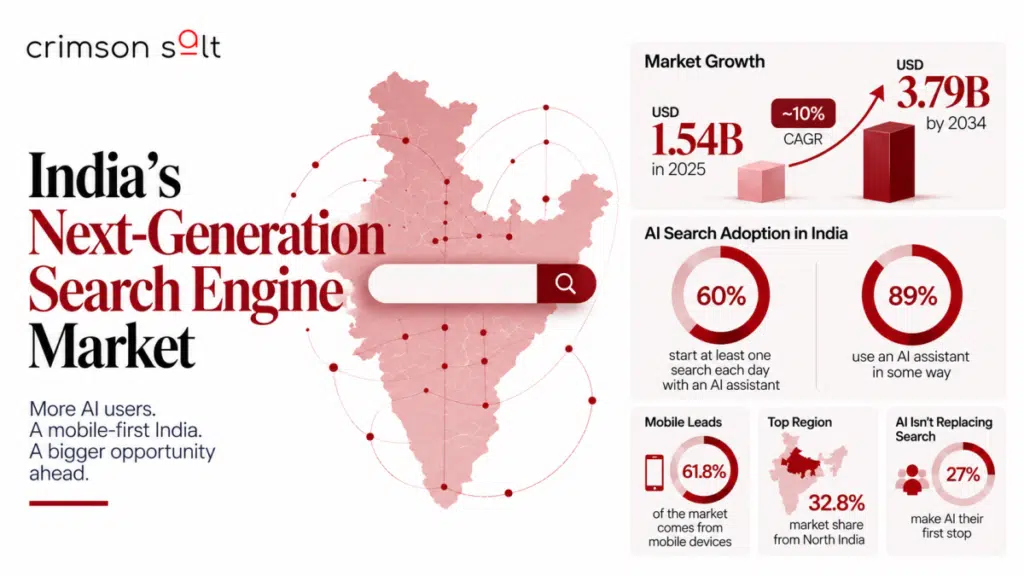
- In 2025, India’s AI search market was worth USD 1.54 billion. It should reach USD 3.79 billion by 2034, growing about 10% a year (IMARC Group, 2026).
- 60% of Indians who search online now start at least one search a day with an AI assistant. 89% use one in some way (YouGov, 2026).
- Phones handle 61.8% of this market. North India is the biggest region at 32.8% (IMARC Group, 2026).
- AI has not replaced normal search. Only 27% of users make AI their first stop (YouGov, 2026).
Table of Contents
How big is the India next generation search engines market?
In 2025, the India next generation search engines market was worth USD 1.54 billion. It should grow to USD 3.79 billion by 2034 (IMARC Group, India Next Generation Search Engines Market, 2026).
That is about 10% more each year. By 2030, the market should reach USD 2.51 billion, the halfway mark. By then, AI search will be normal in India, not just something early users try.
The trend is clear. The market was USD 0.95 billion in 2020. It added about USD 0.6 billion over the next five years. In the nine years after that, it should more than double.
Two facts show where the money is. In 2025, phones drove 61.8% of the market. Online tools made up 84.6%. North India led with 32.8%, and West India came next at 26.9% (IMARC Group, India Next Generation Search Engines Market, 2026).
None of this is a surprise. India goes online on phones first, and more people search by voice each year. This is where our GEO services begin.
How Indians really search now
In 2026, YouGov asked 1,004 city adults in India how they search. 60% now start at least one search a day with an AI assistant. 89% use one in some way (YouGov, How AI Is Changing Online Discovery in 2026). This habit is what the whole forecast is built on. The way people find things has already changed, no matter what the money chart shows.
We covered the full details in another post: which age groups use AI most, and whether people use it to answer a question or to check one. Read The State of AI Search in India 2026 for that. Here, what matters is what this change means for your brand.
The change is not as simple as the headlines say. AI has added to search, not taken over. In 2026, only 27% of Indian users made AI their first stop. Most still check a normal search engine too (YouGov, 2026). So people now search in two ways at once. And more and more, a person’s first look at a brand comes from an AI answer that the brand cannot control. Checking that gap is the point of an AI visibility audit.
Who is competing for the India next generation search engines market?
A few big companies lead the India next generation search engines market. Google is on top, with AI Overviews and Gemini. Close behind are Microsoft (Bing and Copilot), OpenAI (ChatGPT), Perplexity, and Meta (Meta AI) (IMARC Group, India Next Generation Search Engines Market, 2026). Google uses India as a test bed for new AI search. It launched its AI Mode here in June 2025.
What makes India special is reach. Meta is adding AI search inside WhatsApp, Instagram, and Facebook, apps that almost everyone here already uses. Language is the other big edge. AI search in Indian languages should grow much faster than the rest of the market, about 15 to 20% a year, as voice and local languages bring in the next few hundred million users (IMARC Group, 2026).
For a brand, it matters less which company wins. What matters is this: your brand has to be easy for five different AI tools to read at the same time. Most of them never show you a keyword report.
What’s fuelling the growth, and what’s slowing it
Big companies drive much of this growth. By 2026, about 47% of Indian firms already run more than one AI project in real use. Another 23% are still testing (IMARC Group, India Next Generation Search Engines Market, 2026).
Add to that more than 1.02 billion internet users by December 2025. That gives you both new AI tools and a huge crowd ready to use them.
The problems are real too. Google comes pre-set on most phones and browsers, so people have little reason to switch. That is a big hurdle for any rival. Trust is the other brake. AI still makes things up at times.
That is risky for money, health, and legal questions, where a wrong answer costs you. So these AI tools depend on good sources they can point to. That need is the opening for brands. When an AI builds an answer only from sources it can name, being named is what wins the customer.
What this means for your brand
A forecast tells you the chance is real. But the India next generation search engines market reaching USD 3.79 billion by 2034 (IMARC Group, 2026) won’t help you unless you know what to change on Monday.
For fifteen years, the job was to rank high on Google. Someone searched, saw ten links, and clicked yours. Now more and more searches end with one written answer from the AI. The only brands in that answer are the ones the AI can read and trust enough to name. Ranking got you a click. Being named gets you the whole answer.
Our read: When 60% of searchers start their day with AI, the thing that matters is whether the AI names your brand, not where you rank. Ranking is a click. Being named is the verdict.
Three moves follow from these numbers.
- First, write so AI can lift your words. Clear points, real numbers, and answers up front are what an AI copies into its reply. Nice-sounding text that says little no longer earns its place.
- Second, build trust that can be checked. AI leans on brands it can confirm across many sites. It describes a brand with clear, matching facts correctly. It guesses at the rest, or skips it.
- Third, write for voice and for Indian languages, not just English. Phones drive 61.8% of the market, and searches in Indian languages are growing fastest. A brand that shows up for a spoken Hindi or Tamil search wins ground that English-only brands miss.
None of this ends SEO. It builds on top of it. The people using Google and the people using AI are the same people on the same day. You need to be easy to find in both.
Want to know if AI names your brand or just guesses? Run a Crimson Salt AI visibility audit across the five AI tools that shape how India searches.
The bottom line
The India next generation search engines market should reach USD 2.51 billion by 2030 and USD 3.79 billion by 2034, more than double its 2025 size. The change in habits is already here: three in five Indian searchers now start the day with an AI assistant.
Both facts point the same way. The brands that win the next few years won’t chase a big market number. They will be easy for AI to read and name, even when the answer is written without them. Start by checking what AI already says about you. Then fix the gaps. To build the base, begin with what GEO is and why it matters.
Sources
- IMARC Group, India Next Generation Search Engines Market Size, Share, Trends and Forecast 2026-2034, retrieved 2026-09-22, https://www.imarcgroup.com/india-next-generation-search-engines-market
- YouGov, India Web Search and AI Report 2026 / How AI Is Changing Online Discovery in 2026 (primary source; full report is gated), retrieved 2026-09-22, https://yougov.com/reports/55100-india-websearch-ai-report-2026
- YouGov figures (60%, 89%, 27%) as reported by Social Samosa, retrieved 2026-09-22, https://www.socialsamosa.com/report/three-in-five-indians-start-atleast-one-daily-search-with-ai-assistants-12167226
- YouGov figures as reported by News24, retrieved 2026-09-22, https://news24online.com/india/ai-search-india-how-ai-changed-the-way-indians-search-the-internet-60-indian-users-prefer-ai-chatbots-for-web-search-report-reveals-surprising-details/886702/